
Body Language Is a Scoreboard
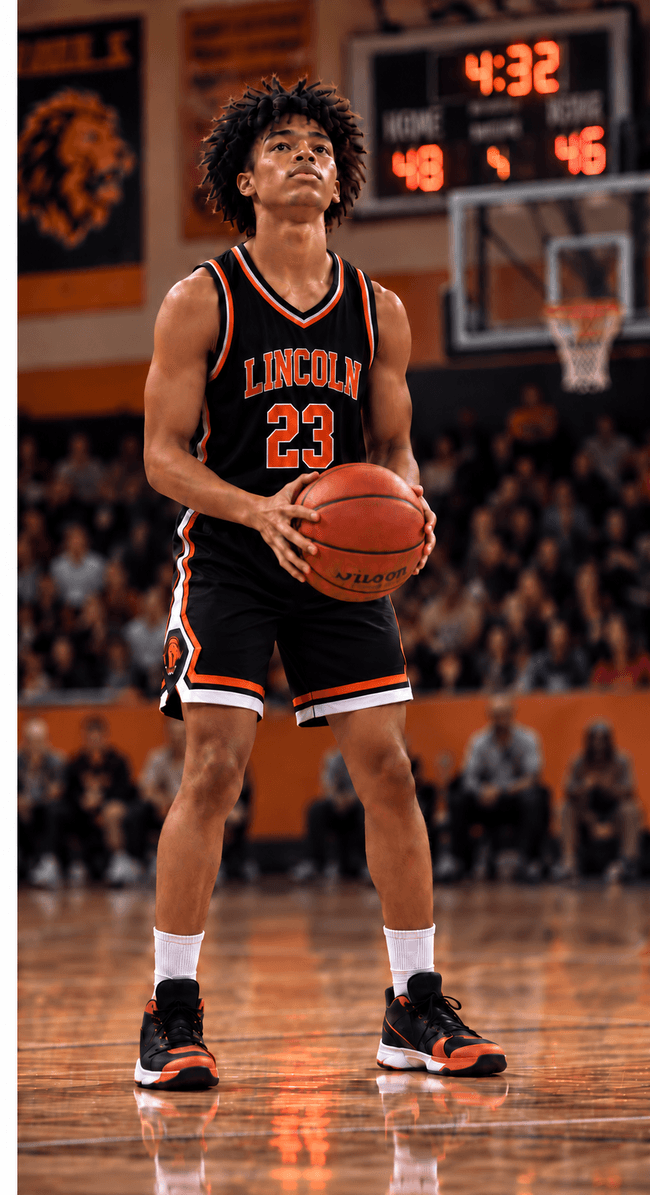
Turn the sound all the way off on a game and watch the bodies. A lot of the time you can guess who's winning the mental battle without ever seeing the score.
The player with his head down, shoulders slumped, hands on his hips, dragging up the floor — he looks like he's losing in his head, whatever the scoreboard says. The player standing tall, clapping for a teammate, sprinting back with his eyes up — he looks like he's in the fight, even if his team is down.
Your body language is a kind of scoreboard other people can read. The question worth asking is: what is yours saying right now?
You're broadcasting to three audiences
Whether you mean to or not, how you carry yourself sends a signal to three people at once.
Your opponent. Defenders read you for weakness. Slumped shoulders after a miss can tell your defender I've got him rattled — and some will play you with more confidence because of it. Stand tall and unbothered and you give them less to read.
Your coach. Coaches notice body language. A player sulking after a sub, or checked out on the bench, sends one message; a player locked in and ready sends another. Geno Auriemma — one of the most successful coaches in college basketball history — has said his staff puts a high premium on body language, and that a player who looks disengaged can struggle to earn minutes (2016 NCAA Women's Final Four press conference). You don't have to take it that far to see the point: how you carry yourself is part of what a coach is reading.
Yourself. This is the one players forget, and it may be the most useful. Your posture doesn't just report your mood — it can feed it. Slumping can drag you further down; standing tall and sprinting with your head up can help pull you back, even when you have to fake it at first. That makes body language a lever you can actually reach during a game.
The thing you can usually control next
You can't always control the emotion. You can usually control the posture. That's the whole point of this one: when the feeling is out of reach, the body is still in reach.
Here are simple swaps — catch the bad one, replace it with the good one, in real time:
- Slumped shoulders → stand tall. Looks steadier, and can help you feel steadier.
- Scowling after a mistake → neutral face or a small nod. Still here.
- Hands up in disgust → clap once, or slap a teammate five. On to the next one.
- Head down, off by yourself → eyes up, get into the huddle. I'm one of us.
- Stomping around → move with purpose, no theatrics. Focused, not fried.
Pick one
You don't fix all of these at once. Malik had one tell — hands up to the ref after a call, pleading. His coach had him kill that one habit and nothing else: every time his hands started to come up, he clapped them together once and sprinted back instead. It took a few weeks. Then it was gone, and the next one was easier.
Do this now
Find your one tell — the thing your body does right after a mistake or a bad call. Ask a teammate or a parent if you're not sure; they've seen it. Pick that one, and for the next few games, replace it with a single better move (a clap, a nod, eyes up). Just the one. That's how this gets built.
This is one chapter of the bigger picture. Locked In is the young hooper's guide to the whole mental game.